·6 min read
Sales Quotation Tracking System for B2B Suppliers: Stop Losing Deals Between Excel and WhatsApp
When price quotes live in scattered Excel files and WhatsApp chats, follow-ups slip, discounts go unchecked and nobody knows why deals are lost. Here is how B2B suppliers can track every quote from request to won or lost.
- sales quotation
- penawaran harga
- quote follow-up
- discount approval
- win rate
- b2b sales
- crm
- sme
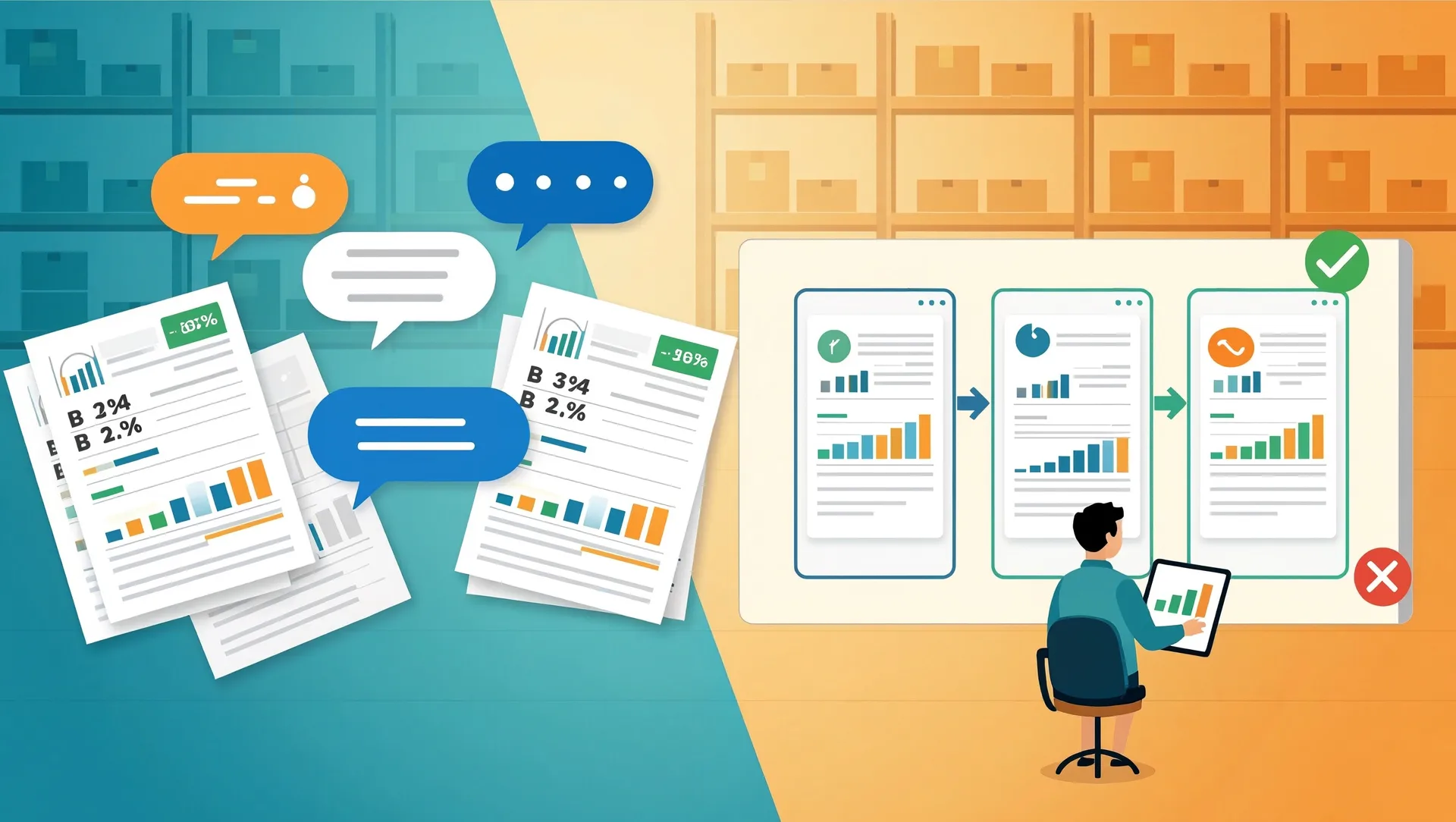
A customer messages your sales rep on WhatsApp asking for a price on 2,000 units. The rep opens an Excel price list (hopefully the latest one), types up a quote, sends a PDF and moves on to the next request. Two weeks later nobody remembers whether the customer replied, who agreed to the 12% discount, or why the order went to a competitor. If your team sends dozens of quotes a week, this is where money leaks. A sales quotation tracking system for B2B suppliers fixes this by recording every quote from request to won or lost. You can see what needs follow-up, protect your margins and raise your win rate.
Where deals get lost between Excel and WhatsApp
Take a typical industrial packaging distributor in Surabaya. It has five sales staff and sends around 60 quotes a week. The price lists are in Excel, and customer conversations happen on personal WhatsApp numbers. Nothing looks obviously broken, and orders keep coming in. But when the owner looks closer, the same four problems keep showing up.
Quotes nobody follows up
A quote goes out, the customer goes quiet, and the rep gets busy with new requests. Many B2B buyers compare three suppliers and pick the one who calls back first. Without a list of open quotes, follow-up depends entirely on memory.
Discounts nobody approved
Reps under pressure to close give 10%, then 15%, sometimes with free delivery on top. On a product with an 18% gross margin, a 15% discount leaves almost nothing. The owner often finds out only when the invoice is issued.
The wrong version gets invoiced
A quote is revised three times, each with a different quantity, price and payment terms. The customer replies 'OK, proceed' to the second version in a WhatsApp chat, but admin invoices the third. Now you have a dispute and an unhappy customer.
No idea why deals are lost
'Customer chose another supplier' tells you nothing. The cause could have been price, lead time, stock or simply a slow response. Without a clear reason, you cannot fix anything.
What a sales quotation tracking system for B2B suppliers should record
You do not need a complicated system. You need every quote in one place, with the same basic information. At minimum, record:
- Quote number and date
- Customer and contact person
- Sales rep responsible
- Items, quantities, unit prices, discount, total and estimated margin
- Version number and what changed in each revision
- Current status
- Next follow-up date
- Who approved the discount, and when
- Final outcome and, if lost, the reason
Keep the statuses simple: Draft, Sent, Negotiating, Won, Lost, Expired. Every quote should sit in exactly one status at any time, and moving a quote to Won or Lost should require a short note.
One more essential point: prices should come from one master price list, not from each rep's own copy of an Excel file. When purchasing updates a price, every new quote picks it up automatically.
Three rules that protect your margin
Software only helps if the rules behind it are clear. These three rules make most of the difference.
1. Every sent quote gets a follow-up date
For example: on day 2, confirm the customer received the quote. On day 5, ask about their decision. On day 10, do a final check, and after that mark the quote as expired. Each morning, reps see a list of quotes due for follow-up today, and the owner sees which ones are overdue.
2. Discounts above a limit need approval
A simple tier structure works well:
- Up to 5%: the rep decides
- 5% to 10%: the sales manager approves
- Above 10%, or below the minimum margin: the owner approves
The approval happens inside the system, through a button or a WhatsApp notification with an approve link. It is recorded with a name and a time. This is not about distrusting your team. It means that when margins drop, you have a record instead of an argument.
3. The customer accepts a specific version
When the customer confirms, the rep marks which version was accepted. The rep also attaches proof, such as a chat screenshot or a signed PO. That version becomes the sales order, and older versions are locked so nobody invoices the wrong one.
Read the numbers: win rate and loss reasons
After two or three months of data, you can answer questions that used to be guesswork:
- Win rate per rep and per product category
- Average time from request to quote, which measures how fast you respond
- Number and value of quotes lost, grouped by reason
- Average discount given by each rep
- Total value of open quotes, which is your pipeline
Suppose you find that 40% of lost quotes are marked 'slow response'. Then the fix is not cutting prices. It is sending quotes within 24 hours. If one rep has the highest win rate and also the highest average discount, that is a conversation worth having.
Keep loss reasons to a fixed list: price, lead time, stock unavailable, payment terms, slow response, project cancelled, other (with a note). Free text feels flexible, but you cannot count it.
Your options and what they realistically cost
Shared spreadsheet
Use Google Sheets with one row per quote. It is free and you can start this week. The downsides: it relies on discipline, has no automatic reminders and makes approvals messy. It also starts breaking down beyond roughly 100 quotes a month or when several reps edit at once. It is still a good way to test your rules.
Off-the-shelf CRM
Tools like Zoho CRM, HubSpot and Odoo, as well as several local Indonesian products, have quotation modules. Expect roughly Rp150,000 to Rp600,000 per user per month, depending on the plan. They are quick to start with. However, many are built around Western sales flows. WhatsApp integration and Indonesian quote formats (PPN, payment terms) may need workarounds or paid add-ons, so you end up adapting to the tool.
Custom-built system
A custom system is built around your price list, discount tiers and quote format. It can connect to the WhatsApp Business API and your accounting software. For a focused quotation tracking system, a realistic budget is around Rp40 to Rp120 million, depending on integrations, plus ongoing maintenance. This makes sense when your quote volume is high or your pricing rules are complex, for example customer-specific prices or volume breaks. It also makes sense when off-the-shelf tools keep forcing workarounds.
Whichever route you take, start with the rules, not the software. Run the spreadsheet version for a month. If your team follows it, you will know exactly what is worth automating.
Here is a simple first step you can take this week. Pull last month's quotes from WhatsApp and Excel into one sheet, and mark each one as won, lost or unknown. The number of 'unknown' quotes alone usually shows how much is slipping through. If you want help designing the workflow or choosing between a CRM and a custom system, CodeWorks can review your current quoting process. We will give you an honest recommendation, even if the answer is that a spreadsheet is enough for now.