·6 min read
Project Cost Tracking for Contractors: Know Whether Each Renovation or Build Job Actually Made Money
Many small contractors only find out a job lost money after handover. This guide shows how to track budget against actual spend for every project so you can catch overruns while there is still time to act.
- job costing
- construction
- contractor
- project budget
- cost overrun
- progress billing
- site materials
- profit margin
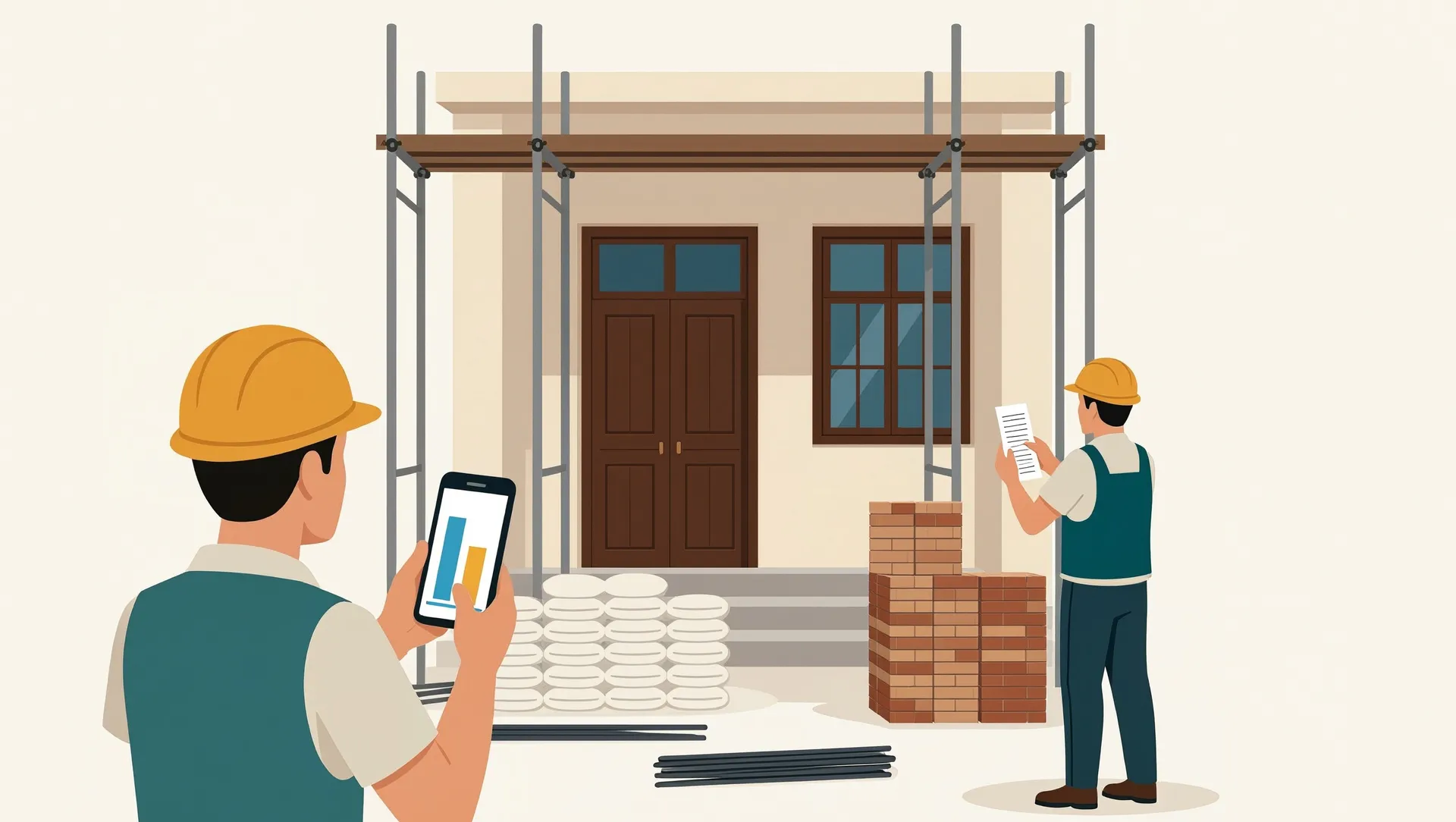
The job is finished. The client has paid the last termin, the site is clean, and the photos look great. Yet when you check the bank balance, the profit you expected is not there. If that sounds familiar, you are not alone. Most small contractors, interior fit-out firms and renovation businesses track their total cash, but not what each job really cost. Project cost tracking for contractors fixes that. It means comparing your budget against your actual spend, job by job, while the work is still in progress, so you see a loss forming in week four instead of discovering it after handover.
This article explains why losses stay hidden, which costs you need to capture, how to connect them to progress billing, and what tools make sense for a business your size.
Why contractors discover losses too late
Almost every contractor starts with a budget, the RAB you prepared for the quotation. The problem is that the RAB usually stays in a folder after the contract is signed. Reality then drifts away from it in small, hard-to-see steps.
- Money from all jobs is mixed together. One bank account and one petty cash box pay for three sites at once. Cement bought for the Kemang house may end up at the Bekasi shop renovation.
- Site purchases happen in cash. The supervisor buys extra tiles at the nearest building store, keeps the receipt in his pocket and hands it in two weeks later, if at all.
- Daily labour is paid every Saturday. Wages for tukang harian come out of cash, often with advances (kasbon) in between, and nobody records which project the workers were on.
- Termin payments create a false sense of profit. When the second termin lands, the account looks healthy. But that money is partly paying for costs you have already incurred and costs still to come.
By the time someone adds everything up, the project is closed and the client is gone. There is nothing left to renegotiate.
The four cost groups to track on every job
You do not need a complicated accounting system to start. You need every rupiah spent to carry two labels: which project and which cost group. These four groups cover most renovation and build work.
1. Site materials
Cement, steel, tiles, gypsum, paint, wiring, plywood. Track the material request from the site, what was actually purchased, and the price. Price differences against the RAB are common, especially for steel and finishing materials, and they add up quickly.
2. Daily labour (tukang harian)
Record the number of worker-days per project each week, not just the total wage bill. If the RAB assumed 60 worker-days for plastering and you are already at 75 with a third of the walls left, you have an early warning, whether the cause is rework, bad weather or slow workers.
3. Subcontractors
AC installation, aluminium windows, waterproofing, built-in furniture. Track the agreed contract value, the payments made so far and any additional work orders. Extra work agreed verbally on site is one of the biggest sources of hidden overruns.
4. Other direct costs
Transport, tool rental, scaffolding, debris removal, permits, site security, meals for workers. Individually they are small. Together they often take 3 to 5 percent of the contract value.
What project cost tracking for contractors looks like in practice
Here is a simple routine that works for a business running two to eight projects at a time.
- Break the RAB into work items. For example: demolition, structure, walls and plastering, MEP, finishing, furniture. Each item gets a budget amount.
- Tag every expense at the source. The site supervisor records each purchase with the project name, work item and a photo of the receipt on the same day. No receipt, no reimbursement.
- Record labour weekly. The foreman submits a simple attendance list per project before wages are paid on Saturday.
- Review once a week. Every Monday, the owner looks at one table per project: budget, actual spend so far, and estimated cost to finish.
- Act on gaps immediately. If an item is running over, decide now: change the method, renegotiate with the subcontractor, or raise a variation order with the client.
The weekly review should take less than 30 minutes. If it takes longer, the data is being collected too late or in the wrong format.
Connecting costs to progress billing (termin)
Tracking costs alone is not enough. You need to compare them with how far the work has progressed and how much you have billed. Take a realistic example.
A shophouse renovation has a contract value of Rp 450 million. Your RAB estimates the cost at Rp 360 million, a 20 percent margin. At the mid-project site inspection (opname), progress is 50 percent. Actual spend so far is Rp 220 million.
At 50 percent progress, the expected cost was Rp 180 million. You are Rp 40 million over. If the same pattern continues, the job will cost around Rp 440 million and your Rp 90 million margin shrinks to about Rp 10 million. That is a job that barely breaks even, and you found out halfway, while you can still act.
Also watch the billing side. If the termin schedule only allows you to bill 40 percent at this stage, you have spent Rp 220 million but received around Rp 180 million. That Rp 40 million gap is being funded from your other projects or your own pocket. Many contractors struggle with cash flow not because they are unprofitable, but because their billing schedule lags behind their spending.
Three numbers per project tell you almost everything: progress percentage, cost spent percentage and billed percentage. When cost runs ahead of progress, you have an overrun. When cost runs far ahead of billing, you have a cash problem.
Spreadsheet, off-the-shelf app or custom system?
Be honest about what your business needs right now.
- Spreadsheet. Free and flexible. It works well for one to three projects if one disciplined person enters the data. It breaks down when supervisors on several sites need to send expenses, because receipts arrive by WhatsApp and someone has to retype everything.
- Accounting software with project tagging. Local cloud accounting tools typically cost a few hundred thousand rupiah per month. They handle invoices, tax and project-based reports well, but they are designed for office staff, not for a supervisor recording material requests on a muddy site.
- A custom system. A simple mobile app for site requests, labour attendance and receipt photos, connected to a dashboard comparing budget, progress and billing. Expect roughly Rp 40 to 150 million depending on scope, plus maintenance. It makes sense when you run many projects at once and the losses from untracked overruns clearly exceed that cost.
Most businesses should start with a well-structured spreadsheet and a strict receipt routine. Move to software only when the routine is working and the manual effort becomes the bottleneck.
Where to start this week
Take your most recently finished project and try to rebuild its real cost from receipts, wage records and subcontractor payments. Compare it with the RAB. The gap you find is usually the best argument for changing how you work. Then apply the four cost groups and the weekly review to the next job you start. If you want help designing a tracking system that fits how your sites actually operate, the CodeWorks team is happy to look at your current process and suggest the simplest setup that works.