·6 min read
Consignment Stock Tracking for Suppliers: Know What Sold, What's Left and What You're Owed at Every Store
Selling through minimarkets, souvenir shops and cafes on consignment is a good way to grow, as long as you know what sold and what you are owed. This guide shows how to track stock per outlet, count it on every visit, calculate settlements and handle returns.
- consignment
- titip jual
- stock reconciliation
- settlement
- retail outlets
- supplier
- inventory
- sme
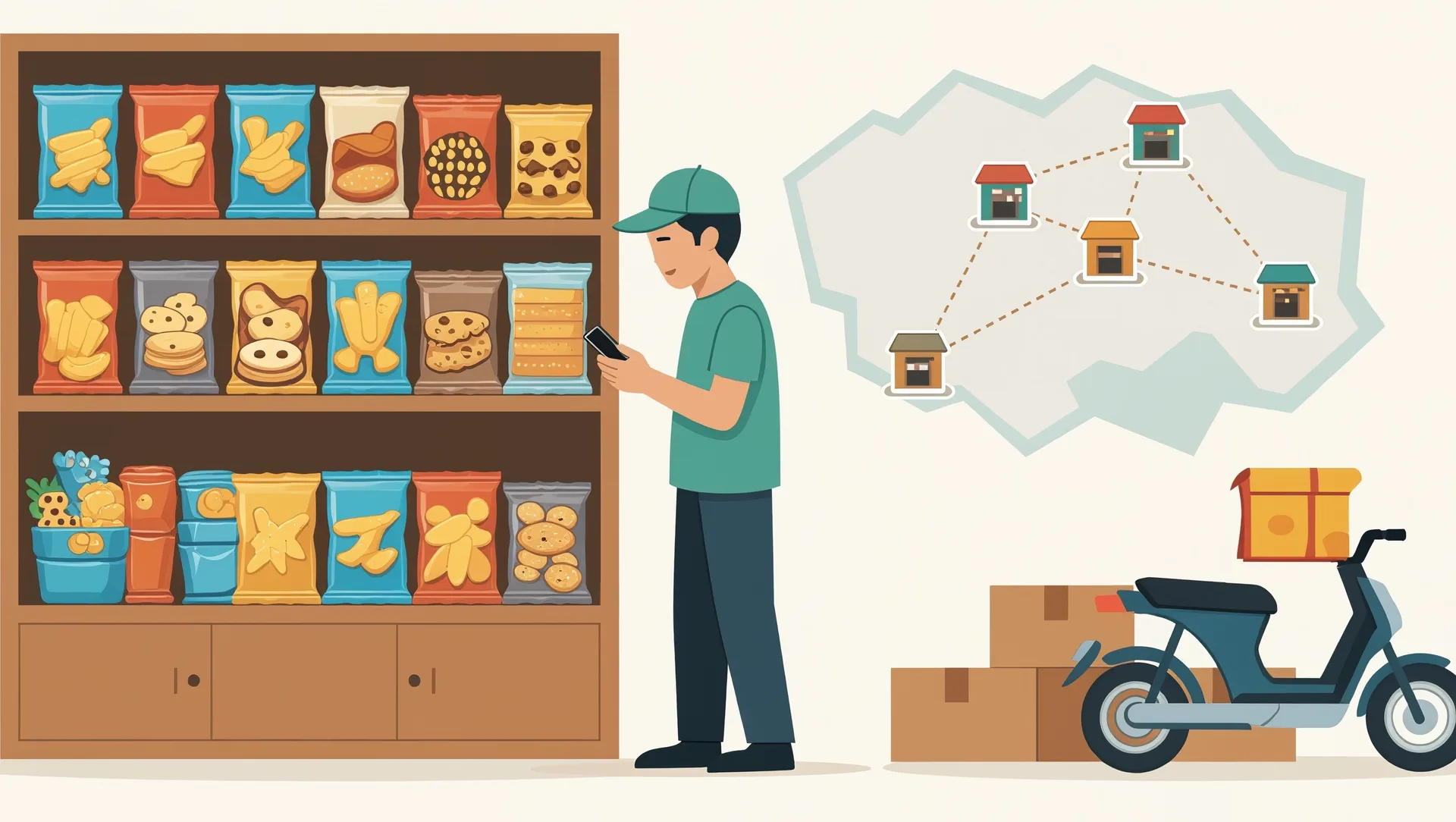
Imagine you make cassava chips and have them on consignment in 40 outlets: minimarkets, souvenir shops, a few cafes and two pharmacies. Every month you hear the same things. We only sold 12 packs. Some were already damaged when they arrived. Payment next month, the owner is away. You suspect you sold more, but you have no records to back it up. Good consignment stock tracking for suppliers fixes this. It is not complicated software. It is a simple habit: record what sits in each outlet, count it on every visit and let the numbers show what you are owed.
This post walks through the method step by step, with real numbers, and ends with honest options for tools at different budgets.
Why consignment gets messy so quickly
With titip jual, the goods are still yours until they sell, but they sit on a shelf you do not control. That creates four common problems:
- No per-outlet stock record. You remember roughly what you dropped off, but not how many packs Toko Sari had after your last visit.
- Reports you cannot verify. The outlet tells you how many sold. Without your own count, you have to take their word for it.
- Damaged and expired goods. Products get crushed, opened or expire. Without an agreement and a record, the loss usually ends up as yours.
- Slow, unclear payment. If neither side has a clear settlement document, payment waits until someone has time to argue about it.
None of this comes from bad intentions. It comes from missing records. Fix the records and most of the arguments disappear.
The core idea: one small ledger per outlet
Treat every outlet as its own small warehouse. For each one you only need to know four numbers per period:
- Stock left after your last visit (opening stock)
- Goods returned or written off as damaged since then
- Stock you count on the shelf today (closing count)
- New goods you deliver today
From these, the sold quantity follows directly:
Sold = opening stock - returned or damaged - closing count
A real example. After your last visit, Toko Oleh-Oleh Sari had 50 packs. Today you count 18 on the shelf and find 2 crushed packs in the back. If your agreement says damage inside the store is the store's responsibility, those 2 count as sold. Sold = 50 - 18 = 32 packs. At a consignment price of Rp 12,000 per pack, Sari owes you Rp 384,000. You then deliver 32 new packs to bring the shelf back to 50, and take the 2 crushed ones back.
That is all there is to it. The method only works if the opening stock is accurate, and it only stays accurate if you count on every visit.
Running a stock count on every visit
The count is the heart of consignment stock tracking for suppliers. Keep it short and the same every time, so your sales staff actually do it.
Before the visit
Prepare a visit sheet for each outlet that already shows the opening stock per product. Your staff should never have to remember it. On paper, a spreadsheet or a phone form, the important thing is that the expected number is already filled in.
At the outlet
- Count every product on the shelf and in the store room, including different flavours or sizes as separate lines.
- Record damaged and near-expiry items separately, with a photo.
- Calculate sold quantity and amount due on the spot.
- Record the new delivery and the returns you take back.
- Ask the store staff to sign or confirm, and take a photo of the shelf.
After the visit
Send the outlet a summary the same day, on WhatsApp is fine: sold quantity, amount due, new stock left, returns taken. When both sides have the same document, a dispute next month becomes a quick check instead of an argument.
A practical tip: count products in fixed groups, for example 10 packs per row on the shelf. It makes counting faster and errors easier to spot.
Settlements and returns without arguments
Agree on the rules in writing
Most payment disputes come from rules nobody wrote down. One page is enough, signed by both sides:
- Price model: a fixed consignment price (you receive Rp 12,000 per pack) or a commission (the outlet sells at Rp 15,000 and keeps 20 percent). Both give the same result here, but write down which one applies.
- Settlement schedule: for example, paid at every visit, or every two weeks by transfer within 7 days of the count.
- Damage and loss: who pays for products that are lost, opened or crushed in the store.
- Expiry: how many days before expiry you collect products, and that those are not charged.
Let the numbers calculate the bill
Once the count is entered, the settlement should calculate itself: sold quantity times price per product, minus agreed write-offs. Doing this by hand for 40 outlets every month takes a day and invites mistakes. In a spreadsheet, it is one formula per row. In an app, it happens the moment your staff submits the count.
Handle returns as their own transaction
Never simply cross out returns. Record them with a reason: expired, damaged by the outlet, damaged by you, or slow-moving. After a few months, this data tells you which outlets are not worth supplying and which products need smaller packs or a longer shelf life. Outlets with high returns and low sales are often cheaper to close than to keep visiting.
Which tool fits your size
You do not need to start with software. Be realistic about where you are:
- Up to around 15 outlets: a well-structured spreadsheet in Google Sheets is enough. One tab per month, one row per outlet per product, formulas for sold and amount due. Cost: free, plus discipline.
- 15 to 50 outlets, a few sales staff: spreadsheets start breaking. Staff overwrite each other's data and nobody trusts the latest file. A general inventory app or a simple phone form linked to the spreadsheet can bridge the gap for a while.
- 50+ outlets or several product lines: a dedicated system starts to pay off: a mobile form for counts, automatic settlement documents, WhatsApp summaries to outlets and a report of overdue payments. A custom build like this typically costs around Rp 30 to 80 million depending on features, plus Rp 300,000 to 1 million per month for hosting and maintenance.
The trade-off is simple. Custom software only makes sense if the money you lose to unclear counts, unpaid stock and wasted visits is larger than the cost. If 40 outlets each underreport 5 packs per month at Rp 12,000, that is already Rp 2.4 million per month, close to Rp 29 million per year.
Start this month
Pick your five biggest outlets. Do a full count at each one on your next visit, set that as the opening stock and use the formula above from then on. After two months, you will know exactly where your stock goes and who pays on time. If you are already handling dozens of outlets and want a system your sales staff can use from their phones, CodeWorks can help you map out what you actually need before you spend anything.